Blog
What Do Clogged Gutters Have To Do With a Wet Basement?


Every fall, St. Louis’s oaks and maples put on a show, and then drop most of it into our gutters. That matters more than it sounds: clogged gutters are one of the most common causes of a wet basement, and leaf season is when they clog fastest.
St. Louis gets more rain than people expect, around 40 inches a year, which is more than Seattle. Much of it comes as short, heavy downpours, which is exactly when a clogged gutter overflows and can do damage. Two inches of rain on 1,000 square feet of roof is roughly 1,200 gallons. With a clogged gutter, much of that lands in one or two spots right against the foundation.
St. Louis soil makes it worse. Much of the area sits on dense clay that drains slowly, so water that pools near the foundation sits there pressing against the basement walls. The clay swells when wet and shrinks when dry, which can open cracks in the foundation over time. And many older homes, from South City bungalows to Webster Groves and Kirkwood, have stone or block foundations that are more prone to seepage than poured concrete.
The good news: a quick check once the leaves start falling can catch most of this.
The Gutter-to-Basement Check
1. Look for overflowing gutters.
From the ground, look for piles of leaves, sagging sections, or water spilling over the edge during rain. If your gutters are above the first story, or you’d have to work from a wet ladder, call a pro.
2. Follow the downspouts.
Make sure each downspout is connected and its outlet isn’t buried or blocked. If your downspouts run underground and water backs up near the house during rain, the buried drain likely needs attention.
3. Move water away from the house.
This is the important part. Downspouts should discharge at least 5 feet from the foundation, the minimum the residential building code requires in areas with clay soils like St. Louis. Ten feet is even better where your yard allows. Watch for puddles or soggy soil along the walls that last more than 24 hours after rain.
4. Check the basement after rain.
Within a day of a good rain, look for damp corners, fresh stains, musty smells, or moisture where the walls meet the floor. Pay extra attention to spots that have leaked before. A dry basement is a good sign, but it doesn’t prove everything is working.
What If the Gutters Are Clean but the Basement Still Gets Wet?
Gutters are only one part of the drainage system.
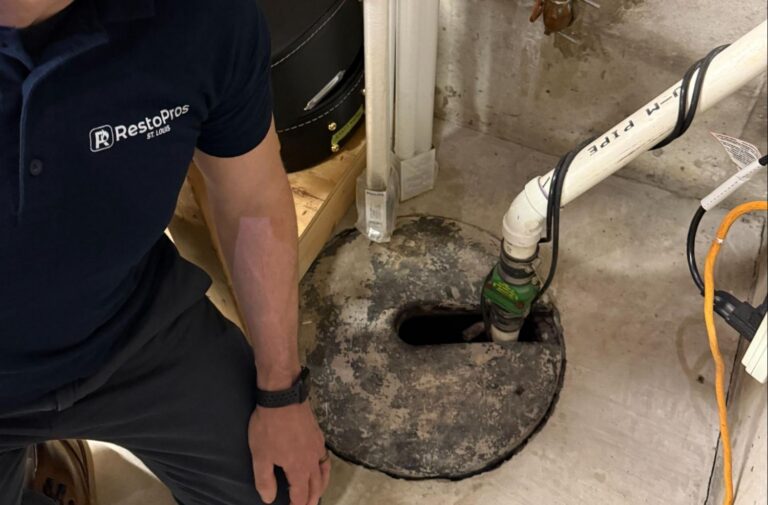
Rainwater can still enter through foundation cracks, poorly graded landscaping, basement window wells, or other drainage problems. A sump pump can help manage groundwater that reaches its collection pit, but it can’t fix every way water can get into a basement. For more on sump pumps, check out our recent post.
If You’re Already Seeing Signs of Water
Sometimes the check turns up a problem that’s already made it inside. A gutter problem doesn’t always mean a flooded basement, and the signs can be subtle. Call us if you notice any of the following:
- Standing water: Stay safe first. Keep away from water near outlets or appliances, and don’t go in if you suspect an electrical hazard.
- Damp walls or floors: Damp spots, fresh stains, or a white chalky residue on the walls mean water is getting in, even if it never puddles. Moisture can stay inside drywall, insulation, and carpet long after the surface looks dry.
- Musty smells or mold: A musty odor that won’t go away usually means moisture has been there for a while.
RestoPros of St. Louis offers 24/7 emergency service and free inspections, with services including water extraction, structural drying, and restoration. We can also refer you to other St. Louis professionals based on what we see. Call us at (314) 377-3776, whether you’re dealing with a puddle or just a smell that won’t go away.
Quick FAQ
At least twice a year, in spring and fall, and more often if your roof is surrounded by trees. During fall, check them as leaves accumulate rather than waiting until the gutters overflow during a storm.
Plan a final fall cleaning once most of the leaves are down, usually late November, and check them along the way if a big storm is in the forecast. In spring, clean them before storm season starts.
Check where the water actually ends up and whether the ground slopes away from the foundation. If water continues to pool or enter the basement, a drainage professional may need to assess the grading, buried drainage lines, or other underlying problem.
Have a damp basement or a smell that won’t go away? Call RestoPros of St. Louis at (314) 377-3776 for a free inspection.