Blog
Moisture Meters and Thermal Imaging: How Pros Find Water You Cannot See
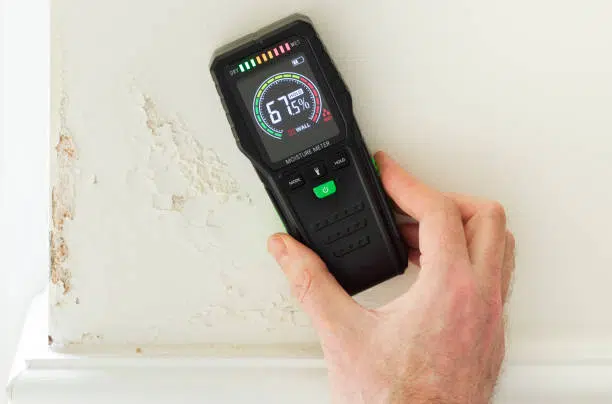
The Short Answer: Moisture meters work by measuring the electrical properties of a building material because water changes how well that material carries or resists an electrical current. Restoration technicians pair those readings with thermal imaging, which reveals temperature patterns that point to water hiding behind walls and under floors.
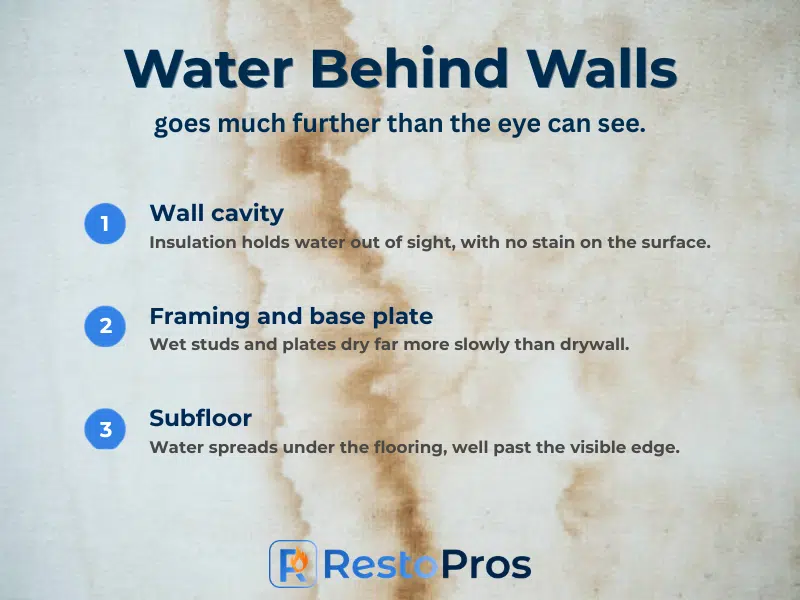
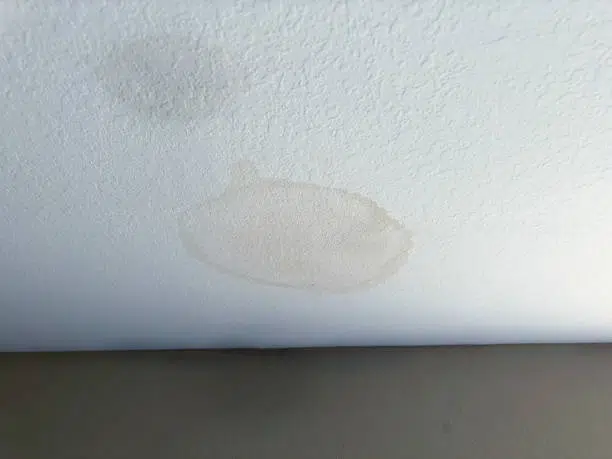
Water rarely stops where you can see it. A supply line leak behind a vanity can travel through the wall cavity, soak into the subfloor, and wick up several feet of drywall while the surface still looks and feels dry. By the time a stain appears, the material behind it has often been wet for days.
That is the problem moisture meters and infrared cameras solve. Below is how the equipment works, what the numbers mean, and how RestoPros technicians use both tools to map water damage before mold has a chance to start.
Why Hidden Moisture Is the Real Problem
Mold needs moisture, a food source, and time to thrive. Wet or damp materials must be dried within 24 to 48 hours for the best chance of avoiding mold growth. Nearly every building material in your home works as a food source, so moisture is the one factor that can be controlled.
Drywall, insulation, and wood flooring hold water long after the surface feels dry to the touch. Finding every wet spot now helps prevent mold problems three weeks later.
How Do Moisture Meters Work?
A moisture meter does not detect water directly. It measures an electrical property of the material and converts that measurement into a moisture reading. Water carries electricity far better than dry wood, drywall, or concrete, so wet material shows less resistance and higher electrical conductivity than the same material when dry.
Restoration work relies on two types of meters, and each answers a different question.
Pin Type Moisture Meters
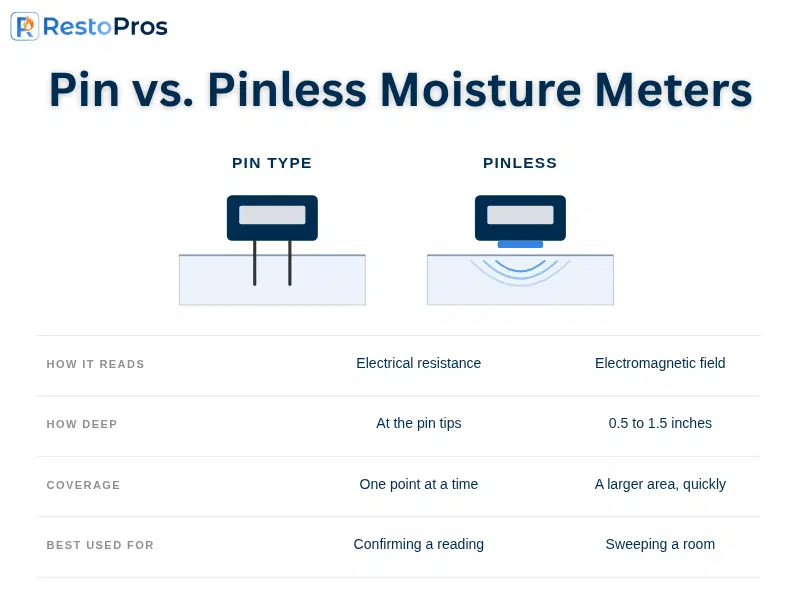
A pin-type moisture meter has two metal probe pins that press into the material. The meter sends a small electrical current between them and measures the electrical resistance. Wet wood offers less resistance, and the meter converts that into a moisture content reading shown as a percentage.
A pin-type meter gives a reading at a known depth, since it only measures between the pin tips. Short pins work for drywall, and long insulated probes can reach a subfloor through carpet and pad. The tradeoff is that a pin meter leaves small holes, so it goes where the reading matters more than the surface.
Calibration matters here. Most pin-type meters are calibrated for wood, so the moisture content reading is accurate for a known wood species. On drywall, plaster, or concrete, the same wood moisture meter reports a wood moisture equivalent, which is compared against dry areas of the same material rather than treated as an absolute water content.
Pinless Moisture Meters
A pinless moisture meter reads without breaking the surface. A sensor pad on the back of the meter sends an electromagnetic wave roughly half an inch to an inch and a half into the material and measures how that field changes. Wet material shifts the field more than dry material, and the meter converts the difference into a moisture level.
Because a non-invasive meter scans a larger area quickly and leaves no holes, a pinless meter is well-suited to sweeping a room to find where water traveled. It is also the safer choice on finished surfaces like hardwood, tile, and cabinetry.
It has limits. A non-invasive meter can be thrown off by metal studs, wire mesh, or foil-backed insulation behind the surface, which is why a reading is confirmed with a pin type meter before anyone decides to remove material.
Pin Type vs. Pinless at a Glance
| Pin Type Meter | Pinless Meter | |
| How it reads | Electrical resistance between two probes | Electromagnetic wave from a sensor pad |
| Depth | Exactly at the pin tips | Roughly 0.5 to 1.5 inches below the surface |
| Coverage | One point at a time | A larger area, scanned quickly |
| Surface | Leaves small pin holes | Leaves no marks |
| Best for | Confirming a reading, checking framing and subfloor | Sweeping a room, finished surfaces, mapping spread |
What Thermal Imaging Adds
An infrared camera does not see moisture. It sees surface temperature. Wet building materials usually run cooler than the dry material around them, because evaporation pulls heat away and wet insulation changes how heat moves through the assembly. On screen, that shows up as a cool pattern with edges that follow the path the water actually took.
Thermal imaging is a search tool rather than a measuring tool. It shows where to point a meter. A single camera scan covers a larger area in seconds and can reveal:
- Water tracking along framing or a ceiling joist
- Wet insulation inside a wall cavity with no staining on the surface
- The spread pattern under a floor, which almost always reaches farther than the visible wet spot
- Cool spots that turn out to be a draft or a cold water line instead of moisture, which is exactly why a thermal finding gets verified with a moisture meter
Why a Professional-Grade Meter Reads Differently
A cheap moisture meter from a hardware shelf gives a general wet or dry impression of surface moisture. A cheap meter usually has one calibration setting, no correction for different materials, and no way to record what it found. That is enough to tell you something is damp. It is not enough to prove a wall assembly reached a drying goal.
A professional-grade moisture meter is built to a published calibration scale and adjusts for different materials, which is what makes a moisture content reading comparable from one day to the next. The restoration industry works to the IICRC S500 standard for water damage restoration, which defines a finished job by measured moisture in the structure rather than by how dry a surface looks or feels. RestoPros technicians are IICRC-certified and use professional-grade equipment meeting IICRC and EPA standards.
A home inspection shows the gap clearly. A home inspector may flag high moisture at a baseboard with a quick moisture tester, and that finding is worth acting on right away. Pinpointing how far the water spread, whether the framing behind it is wet, and what it will take to dry the assembly calls for a different instrument and a technician trained to interpret it.
How RestoPros Uses These Tools on Your Property
- Measure and map: Technicians use moisture meters, built-in hygrometers, and thermal imaging to measure moisture levels, map the damaged area, and find the source of the water.
- Scope before the plan: The full extent of the damage gets mapped before a drying or removal plan is developed, including moisture behind walls, under flooring, and inside HVAC systems.
- Compare against dry material: A reading means little on its own. Restoration technicians take moisture measurements from unaffected material of the same type elsewhere in the building, and that baseline becomes the target for the wet material.
- Read the air, not only the surface: Hygrometer readings of temperature and relative humidity show whether the air in the space can still pull water out of materials, which determines how dehumidifiers and air movers get set.
- Monitor the numbers: RestoPros monitors moisture content and ambient conditions and brings every affected area back to normal moisture levels before the work is done.
What Your Moisture Readings Actually Mean
One number on a screen tells you very little. A reading becomes useful information only when it is compared against something, which is why a dry baseline gets established early.
Relative humidity is important. If the air in the space holds too much moisture, materials stop releasing water, and the daily moisture meter readings flatten out. That signals that equipment needs adjusting rather than more time.
Those readings serve a second purpose. Insurance adjusters expect documented moisture measurements showing what was wet, how wet it was, and when it returned to normal levels.
Get an Accurate Read on the Damage
Water spreads farther than it looks, and drywall that feels dry can still hold enough moisture to grow mold within a couple of days. Moisture meters and thermal imaging exist because the eye is a poor instrument for this work and because guessing leads to either unnecessary demolition or a wall that gets closed up wet.
RestoPros technicians measure moisture levels with moisture meters, built-in hygrometers, and thermal imaging to measure moisture levels and map the damaged area. They also document the findings your insurance provider needs. Inspections are free, our teams are IICRC certified, and we are available 24/7 for water damage and mold remediation.
If you suspect hidden water in your home or building, contact us or find your nearest RestoPros location, and we will get a technician on the way.
Frequently Asked Questions
A pinless meter leaves nothing behind, which is why a non-invasive meter is the usual choice for a first pass across finished surfaces. A pin meter leaves two holes about the width of a sewing needle, normally placed low on a wall or in an area already scheduled for repair.
No. A moisture meter measures water content in a material, not microbial growth. It identifies the conditions mold needs, which is why high moisture readings prompt a closer look. Confirming mold takes a visual inspection and, in some cases, air quality testing.
No. An infrared camera reads surface temperature only. It shows the thermal pattern that wet material creates on the face of a wall or ceiling, and a moisture meter confirms whether that pattern is actually water.
It depends on the material and the conditions, and moisture readings decide the answer rather than the calendar. Dense assemblies like hardwood and plaster hold water longer than drywall. Monitoring continues until the affected area returns to normal moisture levels.
Usually, yes. Adjusters look for documented moisture readings and photos to verify the scope of a claim. RestoPros documents the damage and works directly with your insurance provider throughout the process.